The Paradigm Shift: From Aid to Investment
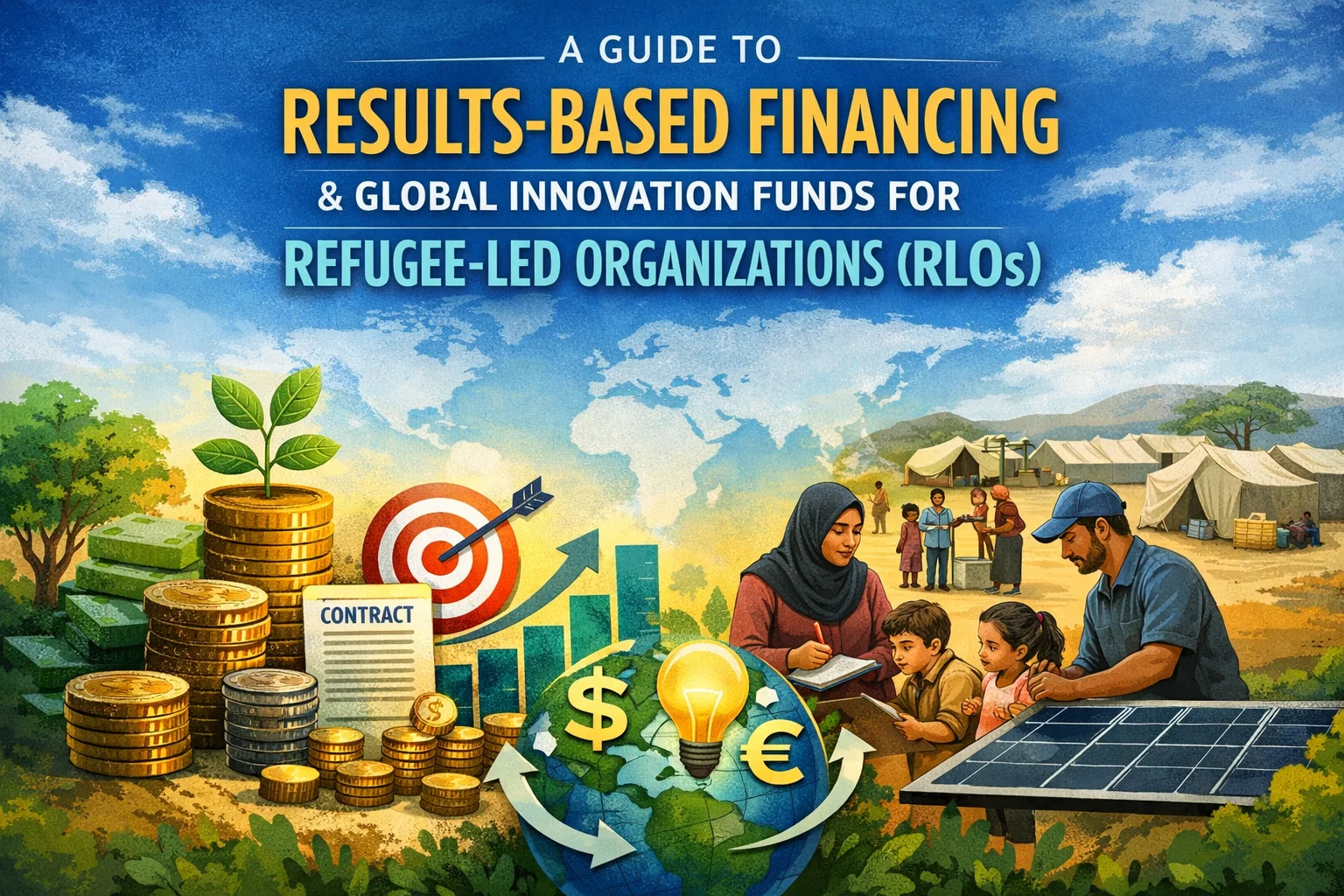
The global humanitarian system is experiencing a “wholesale remaking” in 2026. Facing steep foreign aid cuts, the sector is moving away from short-term service delivery toward Results-Based Financing (RBF). This model recognizes that refugees and migrants are not just aid recipients but economic assets whose integration creates a “win-win” for host communities. For Refugee-Led Organizations (RLOs), this shift provides a pathway to move from precarious survival to institutional scaling.
The UNHCR Refugee-led Innovation Fund
The UNHCR Refugee-led Innovation Fund is at the forefront of this movement. By providing grants of up to $45,000, the fund empowers organizations led by people with lived experience of displacement to identify their own challenges and design community-driven solutions.
Successful RLO Models in 2025-2026:
- Samali Foundation (Ireland): Piloted a postgraduate access program for refugees that recognizes prior learning without requiring formal documentation, dismantling traditional educational barriers.
- Solidarity Initiative for Refugees (SIR) (Kenya): Trained single mothers in the Kakuma Refugee Camp as fashion entrepreneurs, providing e-commerce access and digital literacy.
- Ethio Friends Foundation (Ethiopia): Implemented rainwater runoff systems to recharge aquifers, supporting both refugee and host-community agriculture.
Results-Based Financing: The New Accountability
Under RBF, funding is tied to measurable human outcomes. In a migrant integration context, payments are made only when specific milestones are reached, such as:
- Legal Regularization: Successful attainment of work permits or residency status.
- Economic Inclusion: Formal employment or sustainable business founding.
- Access to Services: Enrollment in healthcare or vocational training programs.
This “outcomes mindset” ensures that limited donor funds are spent effectively, driving a social return on investment (ROI) that often reaches $2 to $7 for every $1 invested. For instance, SOS Children’s Villages reported that for every €1 invested in their programs, society reaped €4.50 in benefits.
Measuring What Matters: ROI of Lived Experience
Academic research in 2024 and 2025 has confirmed that RLOs are often the most efficient providers of assistance because they possess “proximate knowledge” of community needs. The RLO-Led Insights Fund has shown that RLO engagement in policy-making promotes self-reliance and autonomy, fostering a “sense of ownership” that traditional top-down aid lacks. However, RLOs still face a “fiduciary exclusion” gap, where large donors feel they don’t have the bandwidth to manage smaller grants under $500,000.
A Roadmap for RLOs to Scale in 2026
To successfully access the social finance market, RLOs must:
- Define Clear Impact Metrics: Transition from reporting “activities” (e.g., “we held a workshop”) to reporting “outcomes” (e.g., “15% increase in monthly income for participants”).
- Build Strategic Partnerships: Link with local market actors (banks, employers, e-commerce platforms) to ensure refugee businesses are integrated into regional supply chains.
- Invest in Data Capacity: Develop robust systems for tracking and verifying outcomes to meet the “due diligence” requirements of private impact investors.
- Leverage “Patient Capital”: Seek out innovation funds that offer not just cash, but mentorship and capacity building to ensure long-term project sustainability.
By adopting these financial models, RLOs can prove their efficiency and lead their communities toward a future defined by dignity and self-reliance.